
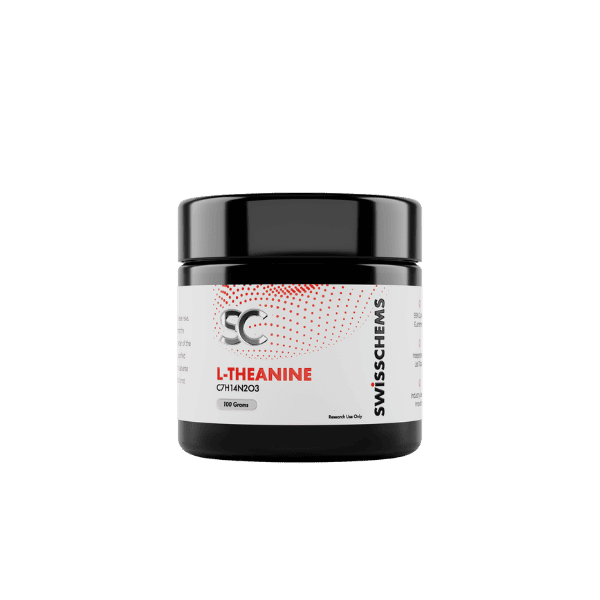
L-Theanine – Powder, 100 grams
$20.98
L-Theanine (γ-glutamylethylamide) is a naturally occurring non-protein amino acid investigated for its effects on glutamatergic, GABAergic, and monoaminergic signaling pathways. Experimental studies have demonstrated interactions with glutamate receptor systems, including NMDA and AMPA receptor-associated signaling… CAS: 3081-61-6 | Formula: C7H14N2O3 | Content: 100 g powder | Research use only | Third-party lab tested.
Buy L-Theanine – Powder, 100 grams – Swiss Chems USA
L-Theanine – Powder, 100 grams — Research Overview
L-Theanine (γ-glutamylethylamide) is a naturally occurring non-protein amino acid investigated for its effects on glutamatergic, GABAergic, and monoaminergic signaling pathways. Experimental studies have demonstrated interactions with glutamate receptor systems, including NMDA and AMPA receptor-associated signaling mechanisms, as well as modulation of glutamate transporter activity. Research has also examined its influence on GABA-related neurotransmission, intracellular signaling cascades, and neurotransmitter regulatory networks. Its well-characterized activity profile makes L-Theanine a valuable research tool for investigations of glutamatergic signaling, receptor pharmacology, neurotransmitter modulation, electrophysiological activity, signal transduction mechanisms, and comparative amino acid neuropharmacology.
- High Purity – 99% Purity Guaranteed
- Independently Lab Tested
- Research Grade Quality
- For Laboratory Research Use Only
Intended use: This material is supplied for laboratory and in-vitro research only. It is not a drug, food, or cosmetic and is not intended for human or animal consumption.
L-Theanine – Powder, 100 grams Chemical Properties
| Property | Specification |
|---|---|
| Chemical Formula | C7H14N2O3 |
| Synonyms | γ-Glutamylethylamide, L-γ-Glutamylethylamide, Suntheanine |
| Molar Mass | 174.20 g/mol |
| CAS Number | 3081-61-6 |
| PubChem CID | 439378 |
| Total Compound Content | 100 g powder |
| Shelf Life | 36 months |
L-Theanine – Powder, 100 grams Research Applications
L-Theanine (γ-glutamylethylamide) is a naturally occurring non-protein amino acid and structural analogue of both glutamate and GABA. Experimental investigations have demonstrated interactions with glutamatergic signaling pathways, including NMDA receptor antagonism, AMPA receptor modulation, and regulation of excitatory amino acid transporter (EAAT)-associated glutamate transport mechanisms. Research has also examined its effects on GABA-related signaling, monoaminergic neurotransmitter regulation, electrophysiological activity patterns, and intracellular signaling cascades associated with neurotransmitter network modulation. Its ability to cross biological membrane transport systems and engage multiple neurotransmitter-associated pathways has made L-Theanine a valuable research tool for investigations of glutamatergic pharmacology, GABAergic modulation, neurotransmitter signaling networks, electrophysiological regulation, receptor-transporter interactions, and comparative amino acid neuropharmacology. The 100 g powder format supports high-volume in vitro, analytical, and experimental research applications. Independently third-party HPLC-tested; COA available per batch.
L-Theanine – Powder, 100 grams Frequently Asked Questions
How does L-theanine modulate glutamatergic signaling despite structural similarity to glutamate?
L-theanine (γ-glutamylethylamide) is structurally related to glutamate, but its ethylamide substitution alters its interactions with glutamate receptor systems and transport mechanisms. Experimental investigations have demonstrated activity at NMDA receptor-associated signaling pathways, where L-theanine functions differently from glutamate despite structural similarity. Studies have also reported modulation of AMPA receptor-associated processes and interactions with excitatory amino acid transporters (EAATs), making L-theanine a useful research tool for examining receptor-ligand specificity, glutamatergic signaling regulation, and amino acid structure-activity relationships.
What is the basis for using L-theanine in electrophysiological research?
L-theanine has been extensively investigated in studies examining electrophysiological activity patterns and neurotransmitter-associated signaling networks. Experimental research has reported effects on oscillatory neural activity, glutamatergic signaling, GABA-associated pathways, and monoaminergic neurotransmitter systems. These characteristics have made L-theanine a valuable tool for investigations of electrophysiological regulation, neurotransmitter network dynamics, receptor-transporter interactions, and signal integration across multiple neurotransmitter systems.
What solvent systems are commonly used for L-theanine in in vitro research applications?
L-theanine is highly water-soluble and is typically prepared in aqueous buffers, phosphate-buffered saline (PBS), or assay-specific media for biochemical and cell-based experiments. Its favorable aqueous solubility facilitates preparation of defined-concentration stock solutions for receptor pharmacology studies, transporter investigations, concentration-response experiments, and other in vitro applications. The compound’s stability and solubility characteristics make it particularly suitable for high-throughput experimental workflows and analytical research programs.
Research Use Disclaimer
All product information is provided for educational and laboratory research reference only. Any form of introduction into humans or animals is prohibited. Handle only in licensed research settings in accordance with applicable laws and institutional protocols.
| Weight | 3.5 lbs |
|---|
Reviews
There are no reviews yet.