
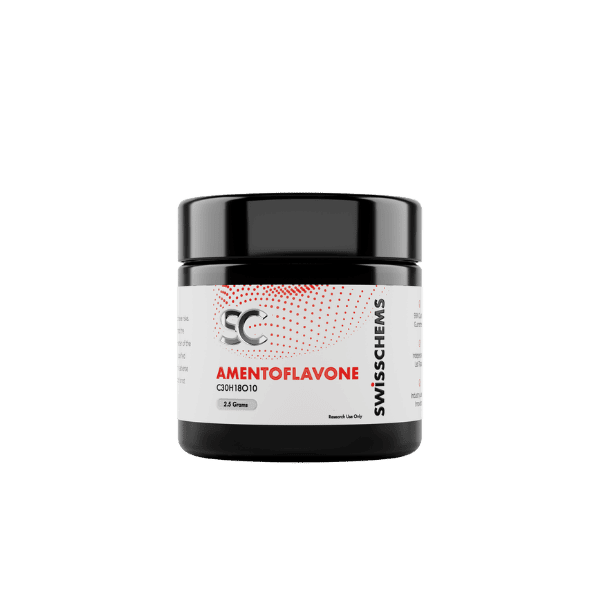
Amentoflavone (20% extract) – Powder, 2.5 grams
$32.99
Amentoflavone is a biflavonoid compound composed of two linked apigenin flavonoid units, classified structurally as 3′,8”-biapigenin. Research interest centers on its receptor-binding profile and enzymatic pathway interactions characterised in controlled in vitro studies, distinguishing it from monomeric flavonoid… CAS: 1617-53-4 | Formula: C30H18O10 | Content: 20% extract (2.5 grams) | Research use only | Third-party lab tested.
Buy Amentoflavone (20% extract) – Powder, 2.5 grams – Swiss Chems USA
Amentoflavone (20% extract) – Powder, 2.5 grams — Research Overview
Amentoflavone is a biflavonoid compound composed of two linked apigenin flavonoid units, classified structurally as 3′,8”-biapigenin. Research interest centers on its receptor-binding profile and enzymatic pathway interactions characterised in controlled in vitro studies, distinguishing it from monomeric flavonoid compounds due to its dimeric structure. Research applications include biflavonoid structure-activity studies, enzymatic pathway research, and comparative flavonoid dimerization chemistry investigation.
- High Purity – 99% Purity Guaranteed
- Independently Lab Tested
- Research Grade Quality
- For Laboratory Research Use Only
Intended use: This material is supplied for laboratory and in-vitro research only. It is not a drug, food, or cosmetic and is not intended for human or animal consumption.
Amentoflavone (20% extract) – Powder, 2.5 grams Chemical Properties
| Property | Specification |
|---|---|
| Chemical Formula | C30H18O10 |
| Synonyms | Didemethyl-ginkgetin, 3′,8”-Biapigenin, Amenthoflavone |
| Molar Mass | 538.5 g/mol |
| CAS Number | 1617-53-4 |
| PubChem CID | 5281600 |
| Total Compound Content | 20% extract (2.5 grams) |
| Shelf Life | 36 months |
Amentoflavone (20% extract) – Powder, 2.5 grams Research Applications
Amentoflavone is studied as a representative biflavonoid, with its dimeric apigenin-derived structure providing a distinct molecular scaffold relative to monomeric flavonoids for structure-activity relationship research. In vitro enzymatic and receptor-binding assays have characterised its interactions with specific molecular targets, with the biflavonoid linkage itself studied as a structural variable influencing binding geometry and affinity compared to the corresponding monomeric apigenin unit. The 20% extract format reflects standardised concentration preparation for consistent dosing across experimental protocols. Independently third-party HPLC-tested; COA available per batch.
Amentoflavone (20% extract) – Powder, 2.5 grams Frequently Asked Questions
How does amentoflavone’s biflavonoid structure distinguish it from monomeric flavonoid compounds in research?
Amentoflavone consists of two apigenin flavonoid units joined at a specific linkage position (3′,8”-biapigenin), creating a larger, more rigid molecular scaffold than monomeric flavonoids. This dimeric structure is studied for how it influences receptor-binding geometry, membrane permeability, and target selectivity compared to the corresponding monomeric apigenin unit, providing a model system for biflavonoid structure-activity relationship research more broadly.
What is the significance of using a standardized 20% extract format in amentoflavone research protocols?
A standardised extract percentage (20% amentoflavone content by weight) ensures researchers can calculate precise active-compound dosing from a consistent starting material, which is important for reproducibility when the extract is derived from plant source material that can have variable natural amentoflavone concentration. Researchers should account for this 20% standardisation when converting total extract mass to active amentoflavone mass for molar concentration calculations in experimental protocols.
What enzymatic assay approaches are used to characterize amentoflavone’s molecular target interactions?
Standard approaches include enzyme inhibition assays measuring amentoflavone’s effect on relevant enzymatic activity (using purified enzyme preparations and substrate-conversion readouts), alongside receptor or protein-binding assays such as fluorescence polarization or surface plasmon resonance to directly characterise binding affinity. Comparative assays run alongside the monomeric apigenin unit are often used to determine whether the biflavonoid linkage enhances, reduces, or otherwise alters target engagement relative to the parent monomer.
Research Use Disclaimer
All product information is provided for educational and laboratory research reference only. Any form of introduction into humans or animals is prohibited. Handle only in licensed research settings in accordance with applicable laws and institutional protocols.
| Weight | 0.09 lbs |
|---|
Reviews
There are no reviews yet.