
Methylene Blue Solution
$15.99
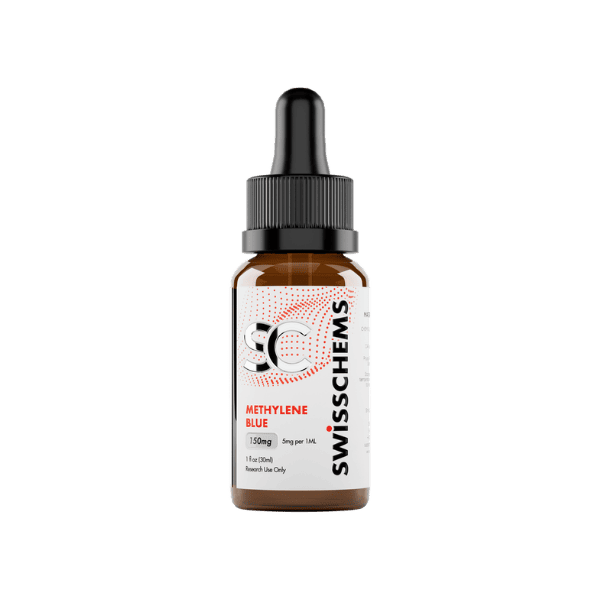
Methylene Blue solution (5 mg/ml) provides the same phenothiazine redox mediator as the capsule format in a pre-dissolved aqueous solution, enabling precise volume-based dosing and immediate use without powder weighing or dissolution steps. The solution format is suited to parenteral administration route studies (IP,… CAS: 61-73-4 | Formula: C16H18ClN3S | Content: 150 mg (5 mg per 1 ml) | Research use only | Third-party lab tested.
Buy Methylene Blue Solution – Swiss Chems USA
Methylene Blue Solution — Research Overview
Methylene Blue solution (5 mg/ml) provides the same phenothiazine redox mediator as the capsule format in a pre-dissolved aqueous solution, enabling precise volume-based dosing and immediate use without powder weighing or dissolution steps. The solution format is suited to parenteral administration route studies (IP, IV, SC) in preclinical models and to in vitro assays requiring defined aqueous methylene blue concentrations. Research applications are identical to the capsule format: mitochondrial ETC bypass, tau aggregation inhibition, MAO inhibition, and photodynamic research.
- High Purity – 99% Purity Guaranteed
- Independently Lab Tested
- Research Grade Quality
- For Laboratory Research Use Only
Intended use: This material is supplied for laboratory and in-vitro research only. It is not a drug, food, or cosmetic and is not intended for human or animal consumption.
Methylene Blue Solution Chemical Properties
| Property | Specification |
|---|---|
| Chemical Formula | C16H18ClN3S |
| Synonyms | Methylthioninium chloride, 3,7-Bis(dimethylamino)phenothiazin-5-ium chloride |
| Molar Mass | 319.85 g/mol |
| CAS Number | 61-73-4 |
| PubChem CID | 6099 |
| Total Compound Content | 150 mg (5 mg per 1 ml) |
| Shelf Life | 24 months |
Methylene Blue Solution Research Applications
Methylene Blue solution (5 mg/mL) contains the same phenothiazine-derived redox-active compound as the capsule format in a pre-dissolved aqueous preparation. The solution format is useful for analytical chemistry applications, solution-based experimental systems, assay development, concentration-response investigations, and studies requiring precise concentration control without additional formulation steps. Methylene Blue functions as a reversible redox-active molecule capable of cycling between oxidized and reduced states, making it a valuable research tool for investigating electron-transfer processes, redox chemistry, mitochondrial signaling mechanisms, and molecular oxidation-reduction pathways. Experimental studies have also examined its interactions with enzyme-associated signaling systems, protein aggregation processes, photochemical reactions, and spectrophotometric applications supported by its characteristic absorbance profile. Independently third-party HPLC-tested; COA available per batch.
Methylene Blue Solution Frequently Asked Questions
What are the practical advantages of methylene blue solution over capsules for preclinical research?
The solution format enables parenteral administration routes (IV, IP, SC) not feasible with capsules, which are limited to oral delivery. For in vitro assays, direct dilution from the 5 mg/ml stock into assay medium avoids organic solvent introduction that capsule powder dissolution typically requires. Volume-based dosing also eliminates powder weighing steps and the associated measurement error in small-dose animal studies. The capsule format is preferred for oral administration protocols where solution handling is not required.
What concentration range should researchers use for methylene blue in mitochondrial ETC bypass applications?
For mitochondrial ETC Complex III bypass studies, methylene blue is typically active at nanomolar to low micromolar concentrations in cell-based assays (0.1–10 µM). At these concentrations, the redox potential of MB/MBH2 cycling enables electron shuttling between NADH/Complex I and cytochrome c, bypassing Complex III. Importantly, MB exhibits hormetic behaviour — low concentrations are cytoprotective (ETC enhancement), while higher concentrations (>10–100 µM) can be pro-oxidant. The 5 mg/ml stock (15.6 mM) requires approximately 1,000-fold dilution for typical assay working concentrations.
How does the methylene blue solution format support photodynamic research applications?
Methylene Blue absorbs maximally at 664 nm and, upon irradiation at this wavelength, undergoes intersystem crossing to its excited triplet state, which transfers energy to molecular oxygen to generate singlet oxygen (¹O₂) — the primary cytotoxic species in photodynamic applications. The solution format simplifies preparation of defined MB concentrations for photosensitisation experiments, enables even distribution in assay well plates without dissolution heterogeneity, and allows precise control of photosensitiser concentration. Irradiation source intensity, exposure duration, and MB concentration are the key experimental variables in photodynamic research protocols.
Research Use Disclaimer
All product information is provided for educational and laboratory research reference only. Any form of introduction into humans or animals is prohibited. Handle only in licensed research settings in accordance with applicable laws and institutional protocols.
Related products
BPC-157 + TB-500 (Blend)
Price range: $119.95 through $1,349.50
GHK-Cu Copper Peptide
Price range: $24.70 through $689.50
Reviews
There are no reviews yet.