
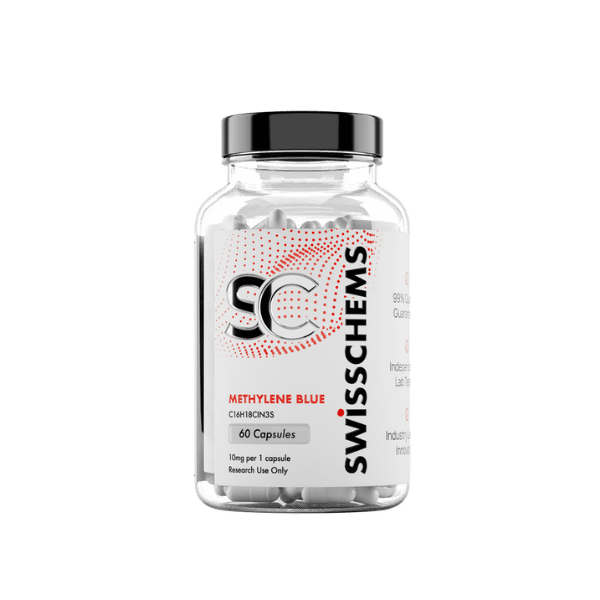
Methylene Blue 10mg/60caps
$16.99
Methylene Blue is a heterocyclic aromatic chemical compound functioning as a redox indicator in research applications. The compound demonstrates selective inhibition of guanylate cyclase and modulation of nitric oxide-dependent pathways in experimental models. Methylene Blue exhibits electron transfer properties in… CAS: 61-73-4 | Formula: C16H18ClN3S | Content: 600 mg (10 mg per capsule) | Research use only | Third-party lab tested.
Buy Methylene Blue 10mg/60caps – Swiss Chems USA
Methylene Blue 10mg/60caps — Research Overview
Methylene Blue is a heterocyclic aromatic chemical compound functioning as a redox indicator in research applications. The compound demonstrates selective inhibition of guanylate cyclase and modulation of nitric oxide-dependent pathways in experimental models. Methylene Blue exhibits electron transfer properties in oxidation-reduction reactions and serves as a photosensitizer in chemical analysis.
- High Purity – 99% Purity Guaranteed
- Independently Lab Tested
- Research Grade Quality
- For Laboratory Research Use Only
Intended use: This material is supplied for laboratory and in-vitro research only. It is not a drug, food, or cosmetic and is not intended for human or animal consumption.
Methylene Blue 10mg/60caps Chemical Properties
| Property | Specification |
|---|---|
| Chemical Formula | C16H18ClN3S |
| Synonyms | Methylthioninium chloride, 3,7-Bis(dimethylamino)phenothiazin-5-ium chloride |
| Molar Mass | 319.85 g/mol |
| CAS Number | 61-73-4 |
| PubChem CID | 6099 |
| Total Compound Content | 600 mg (10 mg per capsule) |
| Shelf Life | 36 months |
Methylene Blue 10mg/60caps Research Applications
Methylene Blue is a phenothiazine-class redox-active compound with a reduction potential of approximately +11 mV, enabling reversible cycling between oxidized and reduced states. This property allows it to function as an electron carrier within oxidation-reduction systems and mitochondrial electron transport-associated pathways. Experimental investigations have examined its ability to accept electrons from NADH/NADPH-dependent redox systems and participate in electron transfer processes involving cytochrome-associated signaling networks and mitochondrial redox mechanisms. Additional research has characterized interactions between Methylene Blue and protein aggregation systems, soluble guanylyl cyclase-associated signaling pathways, and concentration-dependent enzyme interaction profiles. The compound also exhibits well-defined photochemical properties, including strong absorption within the red region of the visible spectrum and the ability to participate in light-mediated redox reactions. These characteristics have established Methylene Blue as a valuable research tool for investigating electron transport dynamics, redox-regulated signaling processes, photochemical mechanisms, phenothiazine pharmacology, and oxidation-reduction pathway biology. Supplied in 10 mg capsules. Independently third-party HPLC-tested; COA available per batch.
Methylene Blue 10mg/60caps Lab Results & Certificates of Analysis
Third-party analytical reports associated with this research compound:
Methylene Blue 10mg/60caps Frequently Asked Questions
How does Methylene Blue participate in electron transfer processes?
Methylene Blue possesses a reduction potential of approximately +11 mV and can reversibly cycle between oxidized and reduced states. This redox behavior enables participation in electron transfer reactions involving NADH/NADPH-dependent systems, cytochrome-associated pathways, and mitochondrial electron transport-related processes. These characteristics have made Methylene Blue a valuable research tool for investigating electron transport dynamics, oxidation-reduction mechanisms, and redox-regulated signaling networks.
What interactions have been reported between Methylene Blue and protein aggregation systems?
Experimental investigations have examined interactions between Methylene Blue and protein aggregation pathways, including studies of protein assembly dynamics, intermolecular association processes, and aggregation-related structural transitions. Its well-characterized molecular properties have established Methylene Blue as a useful compound for investigating aggregation mechanisms, protein interaction networks, and the physicochemical factors influencing protein organization.
Why is Methylene Blue widely used in redox chemistry research?
Methylene Blue combines well-defined electron transfer properties, reversible redox cycling, and established photochemical characteristics within a single molecular scaffold. These features have made it a widely utilized reference compound for studies involving redox signaling, electron transport mechanisms, oxidation-reduction reactions, photochemical processes, phenothiazine pharmacology, and molecular pathway characterization associated with redox-active compounds.
Research Use Disclaimer
All product information is provided for educational and laboratory research reference only. Any form of introduction into humans or animals is prohibited. Handle only in licensed research settings in accordance with applicable laws and institutional protocols.
Related products
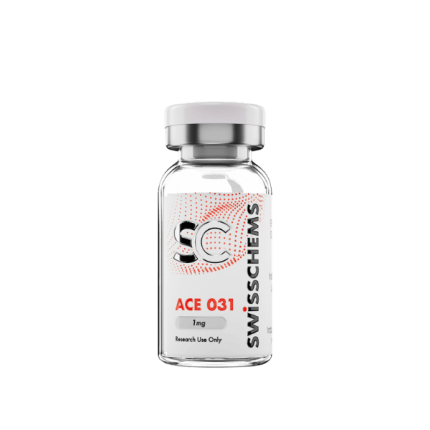
ACE-031 1 mg
Price range: $138.95 through $1,389.50
Reviews
There are no reviews yet.