
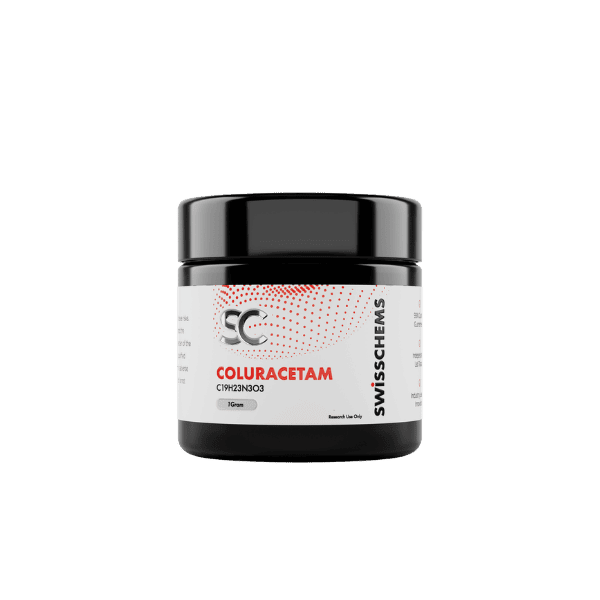
Coluracetam – Powder, 1 gram
$19.99
Coluracetam (MKC-231) is a synthetic compound incorporating a tetrahydrofuroquinoline ring system fused to a pyrrolidinone-derived acetamide substituent, structurally related to but distinct from simpler racetam-class compounds. Research interest centers on its proposed effects on high-affinity choline uptake (HACU)… CAS: 135463-81-9 | Formula: C19H23N3O3 | Content: 1 gram | Research use only | Third-party lab tested.
Buy Coluracetam – Powder, 1 gram – Swiss Chems USA
Coluracetam – Powder, 1 gram — Research Overview
Coluracetam (MKC-231) is a synthetic compound incorporating a tetrahydrofuroquinoline ring system fused to a pyrrolidinone-derived acetamide substituent, structurally related to but distinct from simpler racetam-class compounds. Research interest centers on its proposed effects on high-affinity choline uptake (HACU) in cholinergic neuronal models, including reported activity in HACU-impaired model systems. Research applications include cholinergic transporter pharmacology, HACU restoration studies, and structure-activity relationship research within the furoquinoline-acetamide compound series.
- High Purity – 99% Purity Guaranteed
- Independently Lab Tested
- Research Grade Quality
- For Laboratory Research Use Only
Intended use: This material is supplied for laboratory and in-vitro research only. It is not a drug, food, or cosmetic and is not intended for human or animal consumption.
Coluracetam – Powder, 1 gram Chemical Properties
| Property | Specification |
|---|---|
| Chemical Formula | C19H23N3O3 |
| Synonyms | Coluracetam 135463-81-9, N-(2,3-dimethyl-5,6,7,8-tetrahydrofuran[2,3-b]quinolin-4-yl)-2-(2-oxopyrrolidin-1-yl)acetamide, MKC-231 |
| Molar Mass | 341.4 g/mol |
| CAS Number | 135463-81-9 |
| PubChem CID | 214346 |
| Total Compound Content | 1 gram |
| Shelf Life | 36 months |
Coluracetam – Powder, 1 gram Research Applications
Coluracetam is studied for its reported capacity to enhance or restore high-affinity choline uptake (HACU) in cholinergic neuronal models, including in vitro systems where HACU has been experimentally impaired, distinguishing it from compounds that act only under baseline (non-impaired) conditions. This mechanism is investigated using synaptosome choline-uptake assays and cell models expressing the high-affinity choline transporter, with comparative data generated against other HACU-modulating racetam-family and non-racetam compounds. The furoquinoline-acetamide structure positions coluracetam as a structurally distinct entry point for structure-activity relationship work examining choline transporter modulation outside the classical pyrrolidinone-only racetam scaffold. Independently third-party HPLC-tested; COA available per batch.
Coluracetam – Powder, 1 gram Frequently Asked Questions
How does coluracetam’s effect on HACU in impaired model systems differ from its activity under baseline conditions?
Research distinguishes coluracetam’s reported capacity to restore choline uptake function in experimentally HACU-impaired cell or synaptosome models from simple potentiation of normally functioning choline transport. This distinction is investigated using paradigms that first chemically or genetically impair HACU activity (establishing a reduced-function baseline) before assessing whether coluracetam exposure restores uptake kinetics toward normal-function levels, a different experimental question than measuring potentiation above an already-normal baseline.
What structural features distinguish coluracetam from classical pyrrolidinone-only racetam compounds?
Coluracetam retains a 2-oxopyrrolidinone acetamide substituent characteristic of the racetam family but appends this to a tetrahydrofuroquinoline ring system, a considerably more complex polycyclic structure than the simple substituents found on piracetam, oxiracetam, or pramiracetam. This structural distinction is relevant to structure-activity relationship research examining whether choline-uptake-modulating activity depends primarily on the shared pyrrolidinone-acetamide moiety or is influenced by the broader molecular scaffold to which it is attached.
What assay formats quantify coluracetam’s effects on the high-affinity choline transporter?
Radiolabeled choline uptake assays in synaptosome preparations or in cell lines expressing the high-affinity choline transporter (CHT1) are the standard quantitative method, allowing determination of uptake kinetic parameters (Km, Vmax) under coluracetam exposure relative to vehicle control. These assays are often run in parallel with HACU-impairment paradigms (e.g. using a choline transport inhibitor reference compound) to specifically test coluracetam’s restorative versus potentiating activity profile.
Research Use Disclaimer
All product information is provided for educational and laboratory research reference only. Any form of introduction into humans or animals is prohibited. Handle only in licensed research settings in accordance with applicable laws and institutional protocols.
| Weight | 0.04 lbs |
|---|
Related products
4’-DMA-7,8-DHF ( Eutropoflavin ) 10mg / 60 capsule
Original price was: $49.98.$28.95Current price is: $28.95.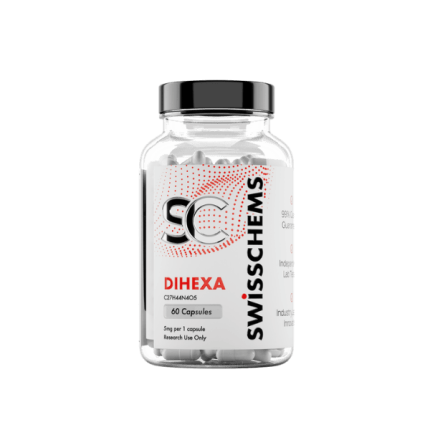
Reviews
There are no reviews yet.