
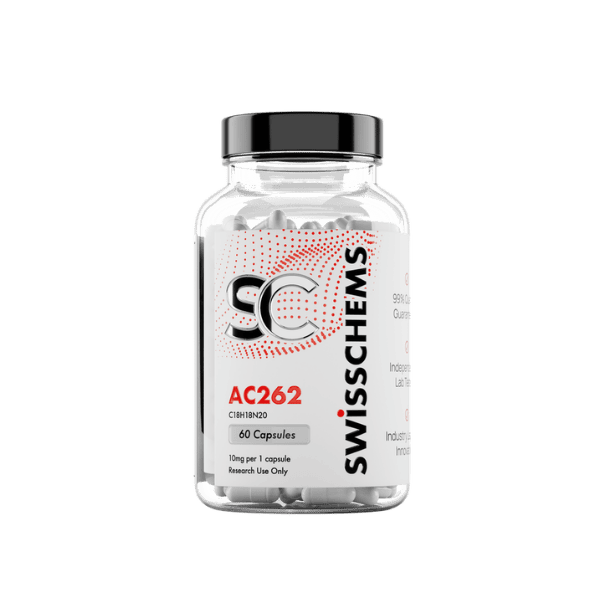
AC-262 (Accadrine), (10mg/capsule) 60 Capsules
$74.95
AC-262 (Accadrine) is a selective androgen receptor modulator (SARM) characterised by tissue-selective binding at the androgen receptor (AR). Research interest centers on its differential activation profile across musculoskeletal versus other AR-expressing tissue models, distinguishing it from non-selective steroidal… CAS: 870888-46-3 | Formula: C18H18N2O | Content: 600mg (10mg per capsule) | Research use only | Third-party lab tested.
Buy AC-262 (Accadrine), (10mg/capsule) 60 Capsules – Swiss Chems USA
AC-262 (Accadrine), (10mg/capsule) 60 Capsules — Research Overview
AC-262 (Accadrine) is a selective androgen receptor modulator (SARM) characterised by tissue-selective binding at the androgen receptor (AR). Research interest centers on its differential activation profile across musculoskeletal versus other AR-expressing tissue models, distinguishing it from non-selective steroidal AR ligands. Research applications include AR binding-affinity assays, tissue-selectivity comparison studies, and SARM structure-activity relationship investigation.
- High Purity – 99% Purity Guaranteed
- Independently Lab Tested
- Research Grade Quality
- For Laboratory Research Use Only
Intended use: This material is supplied for laboratory and in-vitro research only. It is not a drug, food, or cosmetic and is not intended for human or animal consumption.
AC-262 (Accadrine), (10mg/capsule) 60 Capsules Chemical Properties
| Property | Specification |
|---|---|
| Chemical Formula | C18H18N2O |
| Synonyms | AC-262536, 870888-46-3, UNII-U8VS41J5O6, U8VS41J5O6 |
| Molar Mass | 278.3 g/mol |
| CAS Number | 870888-46-3 |
| PubChem CID | 44512434 |
| Total Compound Content | 600mg (10mg per capsule) |
| Shelf Life | 36 months |
AC-262 (Accadrine), (10mg/capsule) 60 Capsules Research Applications
AC-262 (Accadrine) is a non-steroidal SARM compound that engages the androgen receptor with a tissue-selective activation pattern distinct from testosterone and other endogenous androgens. In vitro receptor-binding assays characterise its AR affinity and partial agonist behaviour relative to full agonists such as DHT, while comparative tissue-culture models (musculoskeletal versus other AR-bearing cell lines) are used to investigate the molecular basis of its selectivity. Structure-activity relationship studies position AC-262 within a broader class of arylpropionamide-derived AR ligands under investigation for receptor-selective pharmacology. Independently third-party HPLC-tested; COA available per batch.
AC-262 (Accadrine), (10mg/capsule) 60 Capsules Lab Results & Certificates of Analysis
Third-party analytical reports associated with this research compound:
AC-262 (Accadrine), (10mg/capsule) 60 Capsules Frequently Asked Questions
What distinguishes AC-262 from steroidal androgen receptor agonists in receptor-binding research?
AC-262 is a non-steroidal arylpropionamide-derived androgen receptor (AR) ligand that differs structurally from steroid-based AR agonists. This distinct chemical scaffold produces unique receptor conformations upon binding, influencing co-regulator recruitment and downstream transcriptional activity. As a result, AC-262 is frequently used in comparative receptor pharmacology and structure-activity relationship (SAR) studies investigating how ligand architecture affects AR activation, signalling bias, and gene-expression outcomes.
How is AC-262’s tissue selectivity evaluated in research models?
Tissue selectivity is typically assessed by comparing AR-mediated transcriptional activity across multiple AR-expressing experimental systems using reporter-gene assays, gene-expression profiling, and pathway-activation studies. Differences in potency, efficacy, and transcriptional output between model systems provide insight into selective AR modulation. Combining these functional measurements with receptor-binding data helps distinguish effects related to receptor affinity from those arising through downstream signalling and co-regulator interactions.
What assay formats are commonly used to evaluate AC-262 androgen receptor activity?
Standard approaches include competitive receptor-binding assays to determine relative AR affinity and cell-based transactivation assays utilizing AR-responsive reporter constructs to quantify functional activity. Additional studies often incorporate co-activator recruitment assays, gene-expression analysis, and comparative ligand profiling to characterize receptor activation patterns. Together, these methods provide a comprehensive assessment of receptor binding, signalling efficacy, and selective androgen receptor modulation.
Research Use Disclaimer
All product information is provided for educational and laboratory research reference only. Any form of introduction into humans or animals is prohibited. Handle only in licensed research settings in accordance with applicable laws and institutional protocols.
| Weight | 3 lbs |
|---|
Reviews
There are no reviews yet.