
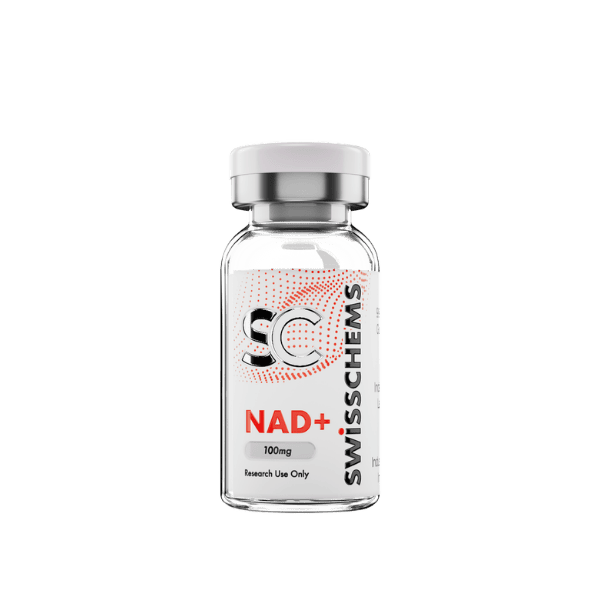
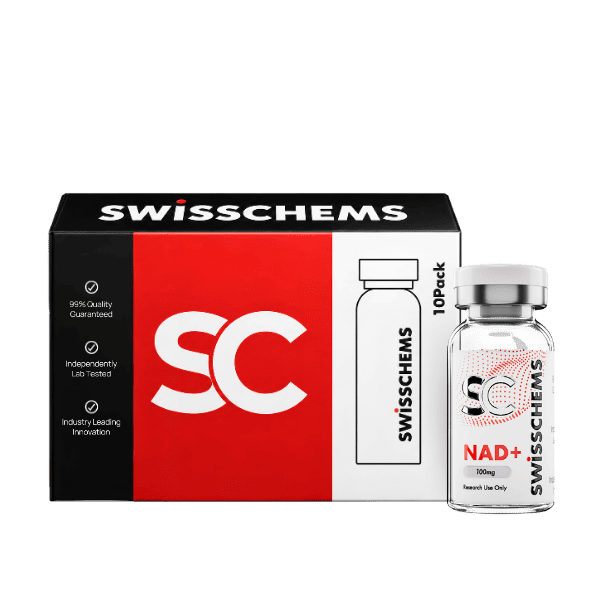
NAD+ (Nicotinamide Adenine Dinucleotide) 100 mg
Price range: $47.95 through $479.50
NAD+ (Nicotinamide Adenine Dinucleotide) is a crucial coenzyme involved in oxidation-reduction (redox) reactions, serving as an electron carrier in cellular bioenergetics. It plays a fundamental role in metabolic pathways, including glycolysis, the citric acid cycle, and oxidative CAS: 53-84-9 | Formula: C21H27N7O14P2 | Content: 100 mg per vial | Research use only | Third-party lab tested.
Buy NAD+ (Nicotinamide Adenine Dinucleotide) 100 mg – Swiss Chems USA
NAD+ (Nicotinamide Adenine Dinucleotide) 100 mg — Research Overview
NAD+ (Nicotinamide Adenine Dinucleotide) is a crucial coenzyme involved in oxidation-reduction (redox) reactions, serving as an electron carrier in cellular bioenergetics. It plays a fundamental role in metabolic pathways, including glycolysis, the citric acid cycle, and oxidative phosphorylation.
This pyridine nucleotide exists in both oxidized (NAD⁺) and reduced (NADH) states, enabling its function in enzymatic catalysis and cofactor-dependent biochemical reactions. NAD+ is metabolized through enzymatic cleavage, salvage pathways, and poly(ADP-ribose) polymerase (PARP) activity, with primary clearance via renal and hepatic pathways.
NAD+ 100 mg should be reconstituted with bacteriostatic water (BAC).
- High Purity – 99% Purity Guaranteed
- Independently Lab Tested
- Research Grade Quality
- For Laboratory Research Use Only
Intended use: This material is supplied for laboratory and in-vitro research only. It is not a drug, food, or cosmetic and is not intended for human or animal consumption.
NAD+ (Nicotinamide Adenine Dinucleotide) 100 mg Chemical Properties
| Property | Specification |
|---|---|
| Chemical Formula | C21H27N7O14P2 |
| Synonyms | nadide, coenzyme I, beta-NAD, beta-nicotinamide adenine dinucleotide |
| Molar Mass | 663.43 g/mol |
| CAS Number | 53-84-9 |
| PubChem CID | 5892 |
| Total Compound Content | 100 mg per vial |
| Shelf Life | 24 months |
NAD+ (Nicotinamide Adenine Dinucleotide) 100 mg Research Applications
NAD+ (nicotinamide adenine dinucleotide) is an oxidized dinucleotide consisting of nicotinamide mononucleotide (NMN) and adenosine monophosphate (AMP) linked by a pyrophosphate bridge. As a redox-active cofactor, NAD+ participates in electron-transfer reactions and oxidation-reduction processes throughout numerous biochemical systems, where it is reversibly converted between oxidized (NAD+) and reduced (NADH) states. The NAD+/NADH ratio is a widely studied regulatory parameter that influences the activity of redox-sensitive enzymes, signaling proteins, and cofactor-dependent biochemical pathways. Beyond redox cycling, NAD+ serves as an obligate substrate for three major enzyme families: PARP-1/-2 (poly(ADP-ribose) polymerases), sirtuins (SIRT1–7, NAD+-dependent deacylases), and CD38/CD157 (ADP-ribosyl cyclases). These enzymes utilize NAD+ in processes involving protein modification, signal transduction, regulatory pathway activation, and cofactor-dependent enzymatic activity. The central role of NAD+ in redox biology and enzyme-cofactor interactions has established it as a valuable research tool for investigating NAD+-dependent signaling networks, sirtuin pharmacology, PARP-associated pathways, and the molecular mechanisms governing cofactor-regulated biochemical systems. Independently third-party HPLC-tested; COA available per batch.
NAD+ (Nicotinamide Adenine Dinucleotide) 100 mg Lab Results & Certificates of Analysis
Third-party analytical reports associated with this research compound:
NAD+ (Nicotinamide Adenine Dinucleotide) 100 mg Frequently Asked Questions
How does NAD+ differ from NAD+ precursor compounds in biochemical research?
NAD+ is the oxidized dinucleotide cofactor itself, whereas compounds such as nicotinamide mononucleotide (NMN) and nicotinamide riboside (NR) participate in NAD+ biosynthetic pathways. This distinction makes NAD+ a useful research tool for investigating NAD+-dependent enzymatic reactions, cofactor utilization mechanisms, redox system dynamics, and the biochemical relationships between NAD+ and precursor-associated pathways.
Which enzyme families utilize NAD+ as a substrate?
NAD+ serves as an obligate substrate for three major enzyme families: poly(ADP-ribose) polymerases (PARPs), sirtuins (SIRT1–7), and CD38/CD157 ADP-ribosyl cyclases. These enzymes utilize NAD+ in processes involving protein modification, enzymatic regulation, signal transduction, and cofactor-dependent biochemical activity. Their dependence on NAD+ has made them important targets for investigations of enzyme-cofactor interactions and NAD+-associated regulatory mechanisms.
Why is NAD+ widely used in biochemical research?
NAD+ occupies a central role in both redox chemistry and enzyme-mediated regulatory systems. In addition to functioning as a reversible electron carrier, it participates directly in the catalytic activity of multiple NAD+-dependent enzyme families. These characteristics have established NAD+ as a valuable research tool for investigating redox biology, enzyme kinetics, cofactor-dependent catalysis, sirtuin pharmacology, PARP biochemistry, CD38-associated pathways, and the molecular mechanisms governing NAD+-dependent biochemical processes.
Research Use Disclaimer
All product information is provided for educational and laboratory research reference only. Any form of introduction into humans or animals is prohibited. Handle only in licensed research settings in accordance with applicable laws and institutional protocols.
| Weight | 1 lbs |
|---|---|
| Nad 100Mg |
1 vial ,KIT (10 vials) |
Related products
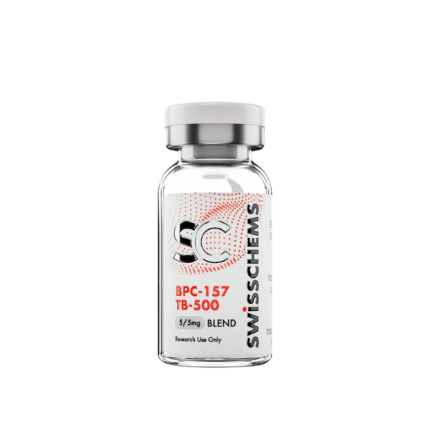
BPC-157 + TB-500 (Blend)
Price range: $119.95 through $1,349.50
Reviews
There are no reviews yet.